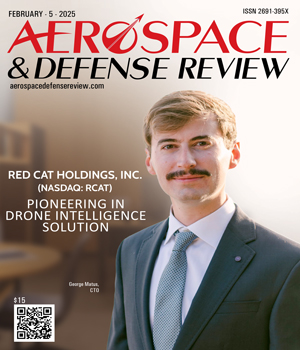
Red Cat Holdings, Inc. (Nasdaq: Rcat): Pioneering In Drone Intelligence Solution

Night Vision Military Drone Company Of The Year - 2025

The accelerating pace of global security challenges and rising operational demands are driving a thrilling wave of innovation in aerospace and defense. The pursuit of faster, smarter and more reliable systems is reshaping the landscape, driving innovation in key areas such as materials science, autonomous systems and next-generation propulsion. Organizations that prioritize technological excellence are meeting today’s complex requirements and setting new industry benchmarks.

Reports highlight that the global aerospace and defense market, valued at $839.57 in 2024, is projected to reach $1326.14 by 2032 at a CAGR of 8.8 percent.

Fueling this transformation are cutting-edge technological trends reshaping aerospace and defense by driving innovation, improving operational efficiency and addressing modern challenges. Latest trends in AI are instrumental in enhancing flight safety.

Autonomous systems and predictive maintenance aid in optimizing flight operations. Additive manufacturing is revolutionizing aircraft production. It reduces lead times and manufacturing costs.

Advanced defense equipment, such as hypersonic weapons and directed energy systems, are providing superior capabilities for tactical superiority. The Internet of Military Things is strengthening situational awareness. It enables real-time decision-making across military operations.

This edition of Aerospace and Defense Review presents insights from industry leaders and innovators driving technological advancements that are transforming the sector. It features Paul Guerrier, manufacturing engineering manager at Moog, who highlights AI’s transformative potential in aerospace manufacturing, enabling defect reduction, boosting productivity and supporting workers through seamless humanAI collaboration. Carrie Haase, chief pilot at Aurora Flight Sciences, emphasizes the integration of autonomy and real-time analysis to enhance safety, streamline testing and improve human-machine collaboration in aerospace operations.

We hope this edition, helps you unlock new opportunities, drive technological advancements and position your organization at the forefront.

 

    Night Vision Military Drone Company Of The Year

    Red Cat Holdings, Inc. (Nasdaq: RCAT)
    Red Cat (Nasdaq: RCAT) is a drone technology company integrating robotic hardware and software for military, government, and commercial operations. Through two wholly owned subsidiaries, Teal Drones and Flightwave Aerospace, Red Cat has developed a bleeding-edge family of ISR and Precision Strike Systems.

A&D Manufacturing Info

Q1
What Do Top A&D Manufacturers Do?
Top A&D Manufacturers design, build and supply the components, assemblies and production capabilities that support aerospace and defense programs. Their work can range from precision machining, fabrication and composite manufacturing to electronics, testing, inspection and final assembly. Many serve aircraft manufacturers, defense contractors, government agencies and space programs that depend on strict quality requirements and long production lifecycles. Unlike many commercial manufacturing sectors, aerospace and defense production often involves detailed documentation, certification requirements and traceability standards. A small issue in a component can create delays across an entire program. That makes manufacturing discipline just as important as production capacity.
Q2
Why Do Top A&D Manufacturers Matter More Today?
The demand facing Top A&D Manufacturers has shifted in recent years. Defense modernization programs, aircraft production recovery, satellite growth and supply chain pressures have increased the need for reliable manufacturing partners. Many organizations are also balancing new production requirements with aging equipment, workforce shortages and stricter compliance expectations. Production schedules leave little room for disruption. A delayed casting, inspection backlog or unavailable supplier can affect delivery timelines across multiple contractors. Buyers are paying closer attention to manufacturing resilience, lead times and quality control because downstream delays often become expensive very quickly.
Q3
How Should Organizations Evaluate A&D Manufacturing Providers?
Organizations should look beyond machine capacity and production volume. A stronger evaluation often starts with process control, certification history, inspection capability and program experience. It is also useful to review how a manufacturer handles documentation, engineering changes and production traceability. One practical test is to examine how a provider manages a design revision or late-stage specification update. Aerospace and defense projects rarely remain static. Manufacturers that can handle revisions without creating confusion in procurement, inspection or assembly workflows tend to be better prepared for complex programs.
Q4
What Business Value Do Top A&D Manufacturers Deliver?
The value extends well beyond producing parts. Top A&D Manufacturers help reduce production risk, improve quality consistency and support long-term program stability. Many aerospace and defense products remain in service for decades, which makes manufacturing reliability especially important. A poorly manufactured component can result in rework, certification delays or maintenance issues later on. In contrast, dependable manufacturing support helps organizations stay on track with production schedules, manage costs and avoid disruptions during assembly and testing. For many defense and aerospace programs, the quality of manufacturing directly affects readiness, availability and lifecycle performance.
Q5
How Are Technology and Manufacturing Expertise Shaping the Sector?
Advanced inspection systems, digital measurement tools, automation and testing technologies are becoming more common throughout aerospace and defense manufacturing environments. Precision measurement and validation processes help manufacturers meet increasingly tight tolerances and quality requirements. Expertise still matters as much as technology. Many aerospace components involve specialized materials, complex geometries or demanding environmental requirements. Manufacturing teams often need to balance production speed with inspection accuracy and regulatory compliance. Even highly automated facilities depend on experienced engineering and quality personnel to prevent costly mistakes before products move further down the supply chain.
Q6
What Should Decision-Makers Prioritize When Comparing Top A&D Manufacturers?
When comparing Top A&D Manufacturers, decision-makers should focus on quality systems, production consistency, traceability, inspection capability and long-term support. Capacity matters, but it should not outweigh process discipline and reliability. It is worth reviewing how a manufacturer handles supplier management, documentation requests, testing requirements and replacement-part production. Aerospace and defense programs often continue for many years after initial delivery. Buyers usually benefit from manufacturers that can support ongoing production, maintenance requirements and program changes without creating additional supply chain complexity. A dependable manufacturing partner often becomes part of the program itself rather than just a supplier.