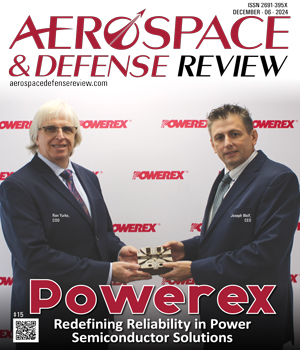
Powerex: Redefining Reliability in Power Semiconductor Solutions

Power Conversion Solution Company Of The Year - 2024

Technological advancements and the growing emphasis on cost-effective, scalable solutions are fueling significant growth in the adoption of power conversion systems within the aerospace and defense sectors.

The aircraft power conversion systems market is projected to shoot from $23.5 billion in 2024 to $50.32 billion by 2031, at a CAGR of 13.54 percent.

A slew of technological advancements are driving this growth. Smart contactors with integrated electronic sensing ensure precise overload monitoring and protection. Features like hall-effect sensors and builtin test functions improve trip accuracy, enhance reliability and adapt to various load conditions, safeguarding systems even under demanding scenarios.

Contactor coil power consumption has been significantly minimized through electronic controls like pulse-width modulation and electronic coil management. These methods reduce heat generation, enhance device longevity and ensure consistent operation, addressing the inefficiencies of traditional mechanical limit switches.

Modern fault detection in aerospace includes advanced techniques for phase rotation, ground faults, and arc fault detection. These innovations safeguard power systems by identifying and mitigating issues before they escalate, ensuring operational continuity and safety compliance.

This edition of Aerospace and Defense Review brings recent developments in power conversion terrain with valuable insights into how companies can use these trends to drive innovation and gain a fierce advantage.

It features insights from industry experts like Gabrielle Carlisle, vice president of manufacturing, supply chain and logistics at Millennium Space Systems, who emphasizes the importance of fostering consistency in products and enhancing employee skillsets to drive efficiency and build a culture of openness, communication and trust. Bob Zimering, director of quality assurance at Lockheed Martin Space, discusses the strategic application of additive manufacturing, emphasizing that it should be used selectively for high-priority missions to yield the best results. These expert opinions contribute to a broader conversation on innovation and strategic decision-making in advanced manufacturing.

We hope this edition will help your organization to forge valuable partnerships to enhance its competitive edge in the industry.
    Power Conversion Solution Company Of The Year

    Powerex
    Powerex is a leading provider of power semiconductor solutions, specializing in high-reliability modules for military and aerospace applications. With decades of expertise, the company employs advanced technologies and a vertically integrated approach to design, manufacture and assemble power modules that meet stringent defense standards.

A&D Manufacturing Info

Q1
What Do Top A&D Manufacturers Do?
Top A&D Manufacturers design, build and supply the components, assemblies and production capabilities that support aerospace and defense programs. Their work can range from precision machining, fabrication and composite manufacturing to electronics, testing, inspection and final assembly. Many serve aircraft manufacturers, defense contractors, government agencies and space programs that depend on strict quality requirements and long production lifecycles. Unlike many commercial manufacturing sectors, aerospace and defense production often involves detailed documentation, certification requirements and traceability standards. A small issue in a component can create delays across an entire program. That makes manufacturing discipline just as important as production capacity.
Q2
Why Do Top A&D Manufacturers Matter More Today?
The demand facing Top A&D Manufacturers has shifted in recent years. Defense modernization programs, aircraft production recovery, satellite growth and supply chain pressures have increased the need for reliable manufacturing partners. Many organizations are also balancing new production requirements with aging equipment, workforce shortages and stricter compliance expectations. Production schedules leave little room for disruption. A delayed casting, inspection backlog or unavailable supplier can affect delivery timelines across multiple contractors. Buyers are paying closer attention to manufacturing resilience, lead times and quality control because downstream delays often become expensive very quickly.
Q3
How Should Organizations Evaluate A&D Manufacturing Providers?
Organizations should look beyond machine capacity and production volume. A stronger evaluation often starts with process control, certification history, inspection capability and program experience. It is also useful to review how a manufacturer handles documentation, engineering changes and production traceability. One practical test is to examine how a provider manages a design revision or late-stage specification update. Aerospace and defense projects rarely remain static. Manufacturers that can handle revisions without creating confusion in procurement, inspection or assembly workflows tend to be better prepared for complex programs.
Q4
What Business Value Do Top A&D Manufacturers Deliver?
The value extends well beyond producing parts. Top A&D Manufacturers help reduce production risk, improve quality consistency and support long-term program stability. Many aerospace and defense products remain in service for decades, which makes manufacturing reliability especially important. A poorly manufactured component can result in rework, certification delays or maintenance issues later on. In contrast, dependable manufacturing support helps organizations stay on track with production schedules, manage costs and avoid disruptions during assembly and testing. For many defense and aerospace programs, the quality of manufacturing directly affects readiness, availability and lifecycle performance.
Q5
How Are Technology and Manufacturing Expertise Shaping the Sector?
Advanced inspection systems, digital measurement tools, automation and testing technologies are becoming more common throughout aerospace and defense manufacturing environments. Precision measurement and validation processes help manufacturers meet increasingly tight tolerances and quality requirements. Expertise still matters as much as technology. Many aerospace components involve specialized materials, complex geometries or demanding environmental requirements. Manufacturing teams often need to balance production speed with inspection accuracy and regulatory compliance. Even highly automated facilities depend on experienced engineering and quality personnel to prevent costly mistakes before products move further down the supply chain.
Q6
What Should Decision-Makers Prioritize When Comparing Top A&D Manufacturers?
When comparing Top A&D Manufacturers, decision-makers should focus on quality systems, production consistency, traceability, inspection capability and long-term support. Capacity matters, but it should not outweigh process discipline and reliability. It is worth reviewing how a manufacturer handles supplier management, documentation requests, testing requirements and replacement-part production. Aerospace and defense programs often continue for many years after initial delivery. Buyers usually benefit from manufacturers that can support ongoing production, maintenance requirements and program changes without creating additional supply chain complexity. A dependable manufacturing partner often becomes part of the program itself rather than just a supplier.